

How to Adjust Fitness Meal Programs for Best Results
Most Bucharest professionals know the struggle of juggling a demanding schedule and healthy eating, yet over 80% of fitness success depends on nutrition according to leading American health studies. Prioritizing personalized meal plans is the fastest route to effective weight management and high training energy, even when days get packed. This guide reveals simple steps to tailor your nutrition starting from an honest self-assessment so you can fuel your workouts like an American athlete and see faster results.
Table of Contents
- Step 1: Assess Current Fitness And Nutrition Needs
- Step 2: Personalize Calorie And Macronutrient Intake
- Step 3: Select Meals Based On Dietary Preferences
- Step 4: Monitor Progress And Adjust Portions
- Step 5: Review Results And Refine Your Plan
Quick Summary
| Key Point | Explanation |
|---|---|
| 1. Assess your current fitness and nutrition | Start with a thorough evaluation of your health, activity, and dietary habits to create a tailored fitness program. |
| 2. Personalize your calorie and macronutrient intake | Calculate your individual nutritional needs based on your metabolic rate and fitness goals for effective meal planning. |
| 3. Choose meals based on your dietary preferences | Align your meal selection with personal preferences and nutritional requirements to maintain motivation and enjoyment. |
| 4. Monitor progress and adjust portions | Regularly track fitness and nutrition metrics to make informed adjustments to portion sizes and macronutrient ratios. |
| 5. Review results and refine your plan | Continuously analyze your outcomes against goals and make informed adjustments to your nutrition strategy for ongoing success. |
Step 1: Assess current fitness and nutrition needs
Successfully adjusting your fitness meal program starts with a comprehensive personal assessment. You need a clear snapshot of your current health status, fitness level, and nutritional baseline to create a targeted strategy that delivers results.
Begin by examining your physical activity patterns and diet quality. This involves evaluating key metrics like your current body composition, aerobic capacity, muscular strength, endurance, and flexibility. Track your typical daily caloric intake, macronutrient balance, and understand how your current eating habits align with recommended nutritional guidelines. Consider scheduling a professional fitness assessment or using specialized tracking tools to gather precise data about your metabolic rate, body fat percentage, and overall fitness indicators.
Your assessment should include detailed documentation of your current lifestyle, exercise routine, dietary preferences, and health goals. Note any existing medical conditions, past injuries, or specific nutritional requirements that might impact your meal and fitness planning. This holistic approach ensures your program is personalized and addresses your unique physiological needs.
Pro tip: Keep a detailed one-week food and activity journal before beginning your assessment to capture the most accurate representation of your current lifestyle and nutritional patterns.
Here is a summary of key factors to assess in your initial fitness and nutrition evaluation:
| Assessment Area | What to Track | Why It Matters |
|---|---|---|
| Body Composition | Weight, body fat % | Establishes baseline health |
| Aerobic Capacity | Cardio routine, endurance | Guides activity adjustments |
| Macronutrient Intake | Protein, carbs, fats | Ensures balanced nutrition |
| Medical History | Conditions, injuries | Informs safe meal planning |
| Lifestyle Habits | Sleep, stress, routines | Impacts overall well-being |
Step 2: Personalize calorie and macronutrient intake
Creating a personalized nutrition strategy requires precise calculation of your unique calorie and macronutrient needs. Your individual metabolic requirements will determine the exact balance of nutrients that supports your fitness goals and overall health.
Start by understanding your specific energy expenditure and nutritional requirements. Personalized diet planning involves carefully calculating your daily caloric needs based on factors like age, gender, height, current weight, activity level, and fitness objectives. Most adults require between 1600 to 3000 calories daily, but this varies dramatically depending on individual metabolism and exercise intensity. Focus on macronutrient distribution: typically 45-65% carbohydrates, 10-35% protein, and 20-35% healthy fats, adjusting these percentages based on whether you aim to build muscle, lose weight, or maintain current fitness levels.
Calculate your specific macronutrient needs by considering your body composition, workout intensity, and health goals. Protein requirements range from 0.8 to 2.2 grams per kilogram of body weight, with athletes and muscle builders needing higher amounts. Track your food intake using nutrition apps or consulting with a registered dietitian to fine-tune your macronutrient balance and ensure you are consuming high-quality, nutrient-dense foods that support your fitness journey.
Pro tip: Invest in a digital food scale and tracking app to measure your macronutrient intake with precision and make data-driven adjustments to your nutrition plan.
Step 3: Select meals based on dietary preferences
Choosing meals that align with your individual dietary needs is crucial for maintaining long-term nutritional success and enjoying your fitness journey. Your meal selection should reflect not just your fitness goals, but also your personal eating philosophy, cultural background, and health requirements.
Start by understanding your core dietary preferences through comprehensive nutrition guidelines that support diverse eating styles. Whether you follow a vegetarian, vegan, ketogenic, paleo, or Mediterranean diet, focus on selecting nutrient dense foods that provide balanced macronutrients and support your specific fitness objectives. Consider factors like protein sources, carbohydrate types, and fat quality that match your metabolic needs. For instance, plant based athletes might prioritize protein rich legumes and grains, while those following a keto approach would emphasize healthy fats and low carbohydrate vegetables.
Evaluate each potential meal option against your nutritional requirements, ensuring it meets your caloric needs, supports your fitness goals, and aligns with your taste preferences. Look beyond simple calorie counts and examine the nutritional profile holistically. Consider working with a nutritionist or using specialized meal planning tools to create a personalized approach that keeps you motivated and properly fueled for your fitness journey.
Pro tip: Create a weekly meal rotation that includes 3-4 flexible meal templates you enjoy, allowing you to maintain variety while simplifying your nutrition planning.
To help personalize your meal selection, here is a comparison of common dietary approaches:
| Diet Type | Main Focus | Typical Protein Sources | Key Benefits |
|---|---|---|---|
| Vegetarian | Plant-based meals | Legumes, eggs, dairy | Supports heart health |
| Vegan | 100% plant-based | Beans, tofu, grains | Reduces cholesterol |
| Ketogenic | Low-carb, high-fat | Meat, nuts, seeds | Enhances fat burning |
| Mediterranean | Whole foods, healthy fats | Fish, poultry, beans | Improves longevity |
Step 4: Monitor progress and adjust portions
Tracking your fitness meal program’s effectiveness requires consistent and strategic progress monitoring. This crucial step transforms your nutrition plan from a static blueprint into a dynamic, responsive strategy that evolves with your body’s changing needs.

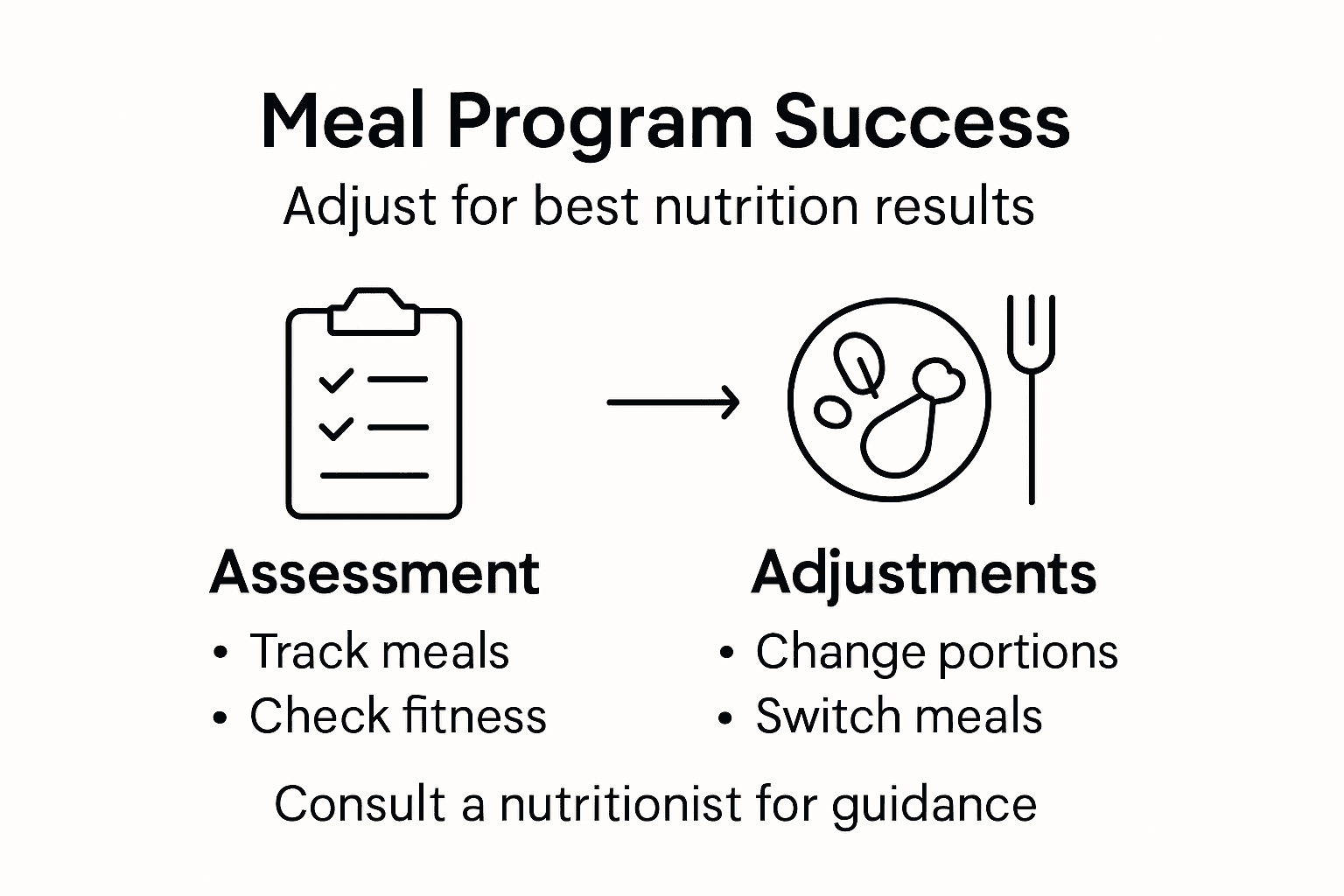
Implement systematic progress tracking methods that go beyond simple weight measurements. Evaluate multiple indicators including body composition, energy levels, workout performance, muscle definition, and overall well being. Take weekly measurements of your weight, body fat percentage, muscle mass, and circumference measurements at key areas like waist, hips, and arms. Photograph yourself monthly from multiple angles to capture visual changes that numbers might not reflect. Use fitness tracking apps or journals to log these metrics consistently, creating a comprehensive data set that reveals your body’s response to your current meal program.
Adjust your portion sizes and macronutrient ratios based on your tracked data. If you are not seeing desired results, make incremental changes rather than drastic modifications. For muscle gain, gradually increase protein and complex carbohydrate portions. For weight loss, slightly reduce total caloric intake while maintaining nutrient density. Remember that progress is not linear, and your body will adapt to your nutrition plan over time, requiring periodic reassessment and strategic adjustments.
Pro tip: Schedule a monthly review of your progress data, treating it like a professional performance evaluation to maintain objectivity and motivation.
Step 5: Review results and refine your plan
Successfully transforming your fitness nutrition strategy requires thoughtful analysis and strategic refinement. Your journey is about continuous improvement, not perfection, and reviewing your results provides the roadmap for sustainable progress.
Personalized meal planning techniques help you evaluate your nutrition approach systematically. Conduct a comprehensive review by comparing your initial fitness goals against your current metrics. Analyze your body composition changes, performance improvements, energy levels, and overall well being. Look beyond simple weight measurements and examine how your muscle mass, strength, endurance, and recovery times have evolved. Consider qualitative factors like workout satisfaction, mental clarity, and motivation levels as critical indicators of your nutrition plan effectiveness.
Refine your meal strategy by making evidence-based adjustments. If certain aspects of your current plan are not delivering desired outcomes, modify your macronutrient ratios, portion sizes, or meal timing. Be patient and make incremental changes rather than dramatic overhauls. Remember that your body is constantly adapting, and what worked initially might require subtle modifications to continue producing results. Treat your nutrition plan as a living document that grows and changes with your fitness journey.
Pro tip: Create a quarterly review spreadsheet that tracks not just physical metrics but also subjective experiences like energy levels and workout performance to identify subtle patterns in your nutrition plan.
Take Full Control of Your Fitness Meal Program Today
Adjusting your fitness meal program to match your unique needs can feel overwhelming. From calculating precise macronutrients to selecting meals that align with your dietary preferences, the challenge lies in managing every detail without losing motivation or time. This article highlights the importance of personalized calorie intake, progress monitoring, and meal selection aligned with your fitness goals — key areas where many struggle to maintain consistency and accuracy.
At Fresh Fitness Food, we understand these obstacles and provide fresh, macro-balanced meals tailored to your exact fitness requirements. Whether you need muscle-building nutrition, weight loss support, vegan or keto options, or help adapting your portions dynamically, our fully customizable plans take the guesswork out of meal prep. Combine this with our lifestyle coaching and you get a comprehensive solution designed to keep you on track effortlessly.

Ready to simplify your fitness nutrition journey and see real results fast Take advantage of personalized meal plans designed by experts who understand your challenges now Visit Fresh Fitness Food to explore our range of targeted fitness meal programs and start refining your results today. Discover how easy it can be to fuel your body properly while focusing on what matters most.
Frequently Asked Questions
How can I assess my current fitness and nutrition needs?
To assess your current fitness and nutrition needs, start by tracking your physical activity and dietary habits for at least a week. Document your body composition, aerobic capacity, and macronutrient balance to establish a clear baseline for moving forward.
What should I consider when personalizing my calorie and macronutrient intake?
When personalizing your calorie and macronutrient intake, consider factors such as your age, gender, height, weight, activity level, and fitness goals. Calculate your specific needs for carbohydrates, proteins, and fats to ensure you are meeting your nutritional requirements for optimal performance.
How do I select meals based on my dietary preferences?
Select meals by understanding your dietary preferences and core nutritional requirements. Focus on nutrient-dense foods that align with your fitness goals and taste preferences, ensuring a balanced intake of macronutrients that supports your regimen.
How do I effectively monitor my progress in a fitness meal program?
To effectively monitor your progress, track various indicators like body composition, energy levels, and workout performance. Take weekly measurements and log them consistently to identify trends and make informed adjustments as you assess your results over time.
What steps should I take to refine my meal plan after reviewing results?
After reviewing your results, refine your meal plan by analyzing your current metrics against your fitness goals. Make evidence-based adjustments to your macronutrient ratios or portion sizes, being patient and making slight changes to facilitate continued progress.
How often should I review my nutrition plan for adjustments?
You should review your nutrition plan for adjustments at least once a month. This allows you to track your progress objectively, refining your approach based on consistent data and any changes in your fitness goals.